
A practical guide to creating a beautiful, relaxed and unforgettable barn wedding reception in Somerset
Barn weddings have a special kind of magic. Exposed wooden beams, rustic stone walls, twinkling fairy lights and beautiful countryside views create a setting that feels romantic, welcoming and full of character. Whether you dream of long banquet tables, seasonal flowers or a relaxed celebration that spills out into the garden, a barn wedding offers plenty of opportunities to make your day personal.
But behind every beautiful barn wedding is a good deal of planning.
Unlike a traditional wedding venue where everything may be provided, a dry-hire barn wedding venue gives you the freedom to choose your own caterers, decorations, furniture and entertainment. That flexibility is wonderful, but it also means thinking carefully about the practical details that will keep your wedding reception running smoothly.
From toilet facilities and seating arrangements to catering logistics and a reliable wet-weather plan, here are the things to consider when planning your perfect barn wedding reception.
1. Start with the space: making the most of your barn wedding venue
One of the biggest attractions of a barn wedding is the character of the building itself. Original stone walls, timber roof trusses and rustic floors provide a beautiful backdrop without needing lots of decoration.
The first step is to understand how you want to use the space throughout the day.
Think about the different stages of your wedding reception:
- Drinks reception: Where will guests gather immediately after the ceremony?
- Wedding breakfast: Where will everyone sit down to eat?
- Speeches: Will these take place between courses or after the meal?
- Evening reception: Where will the dance floor, bar and entertainment be positioned?
- Outdoor space: Could a garden or covered canopy provide extra room for drinks, photographs or relaxed seating?
It is worth walking through the venue and imagining the day from your guests’ perspective. Where will they enter? Where will they put their drinks? Can they move easily between tables without squeezing past chairs? Will older guests have somewhere comfortable to sit away from the music?
A barn that looks wonderfully spacious when empty can feel very different once tables, chairs, decorations, catering equipment and a full complement of guests are in place.
A useful tip: Ask for a floor plan and draw in the furniture before booking any additional equipment. It is much easier to move a table on paper than on the morning of your wedding!
2. Decorating a barn wedding: rustic charm without the clutter
One of the loveliest things about a barn wedding is that the venue often needs less decoration than you might expect.
Natural stone, aged timber and exposed roof beams already provide texture and interest. Rather than covering these features, choose decorations that complement them.
Popular rustic wedding decoration ideas include:
- Seasonal flowers in simple glass bottles or ceramic vases.
- Eucalyptus and foliage garlands along long dining tables.
- Fairy lights to create a warm glow as the evening draws in.
- Lanterns and carefully positioned LED candles.
- Linen table runners, natural fabrics and understated table settings.
- Personal touches such as photographs, handwritten place names and family heirlooms.
If you want to hang decorations from the beams, check what the venue permits before buying anything. Not every barn allows items to be attached to the original structure, and historic stone walls may not be suitable for fixings.
Consider the practical side of decorating, too. Who will put everything up? When can you access the venue? Who will remove the decorations afterwards? If you are hiring a florist or stylist, make sure their setup and collection times are agreed in advance.
Try to avoid filling every available surface. Leaving some of the barn’s natural character visible often creates a more elegant result than an elaborate scheme that competes with the building.
3. Wedding reception seating arrangements: comfort and flow matter
Your seating plan has a bigger impact on the reception than you might think.
Round tables can encourage conversation between guests, while long trestle tables create a relaxed, communal atmosphere that works particularly well in a rustic barn. A mixture of table shapes can also help define different areas within the space.
When planning your wedding reception seating arrangements, consider:
- Guest numbers: Allow enough room for chairs to be pulled out and guests to move comfortably.
- Family groups: Seat people with those they know, while leaving opportunities for different groups to mingle.
- Accessibility: Keep clear routes for wheelchair users and guests with limited mobility.
- Children: Consider highchairs, space for pushchairs and seating close to parents.
- The top table: Decide whether you prefer a traditional top table or a more informal arrangement.
- Entertainment: Make sure the band, DJ and dance floor will not obstruct access to dining tables or exits.
It is also important to think about the transition from the wedding breakfast to the evening reception.
If you want to move dining tables to create a larger dance floor, who will do the moving? Where will guests go while the furniture is rearranged? Can the band or DJ set up without disrupting the evening?
Whenever possible, design the room so that the main furniture can stay in place throughout the day. This reduces the amount of lifting, avoids unnecessary disruption and allows everyone to enjoy the celebration.
4. Catering at a dry-hire wedding venue
Catering is one of the most important logistical considerations when hiring a barn for your wedding.
With a dry-hire wedding venue, you may have the freedom to choose your own caterer and create a menu that reflects your tastes, budget and style. You might prefer a formal three-course wedding breakfast, a relaxed sharing feast, a barbecue, wood-fired pizza or food trucks for the evening.
The important thing is to make sure your chosen caterer understands the venue and has everything needed to deliver the service you want.
Before confirming your catering arrangements, check:
- Is there a suitable catering kitchen or preparation area?
- What refrigeration, freezer space, sinks and work surfaces are available?
- Will your caterer need to bring cooking equipment, serving stations or additional power supplies?
- Where will deliveries arrive, and where can vehicles park?
- Is there enough space for staff to prepare and serve food without crossing busy guest areas?
- Who supplies crockery, cutlery, glassware and serving equipment?
- Who clears plates, washes up and removes food waste?
- What arrangements are needed for evening food and dietary requirements?
Do not assume that tables, chairs, linen, crockery and glassware are included in the venue hire. These can be significant additional costs, so build them into your wedding budget early.
It is also worth arranging a conversation between the venue and your caterer before the wedding. A short site visit can identify practical issues that might otherwise only become apparent on the day.
Remember: The most beautiful menu in the world will not save a reception that is running an hour late because the catering team has nowhere to prepare it!
5. Toilets, facilities and the little details guests notice
Toilets are not the most glamorous part of wedding planning, but they are certainly one of the most important.
Before booking your barn wedding venue, check the number and location of toilets and whether the facilities are suitable for your expected guest numbers. Consider accessibility, baby-changing arrangements, lighting and how easy the toilets are to find once the party gets going.
If the venue has limited facilities, ask whether additional portable toilets are needed and where they could be positioned discreetly.
There are other practical details worth checking, too:
- Is there sufficient parking, with clear directions for guests?
- Are paths and entrances suitable for guests wearing heels or using mobility aids?
- Is there enough lighting between the barn, toilets and outdoor areas after dark?
- Are there enough bins, and who is responsible for emptying them?
- Is there a designated area for coats and bags?
- Where can suppliers unload their equipment?
- Is there a plan for clearing up at the end of the evening?
These details might not appear in your wedding photographs, but they make a real difference to how comfortable your guests feel.
6. The British weather: always have a wet-weather wedding plan
An outdoor wedding ceremony followed by a barn reception sounds idyllic. Imagine exchanging vows in the sunshine, enjoying drinks with countryside views and then gathering inside for dinner as the light fades.
Of course, this is Somerset, and the weather does not always follow the plan!
Even if you are getting married in the height of summer, it is essential to have a realistic alternative for rain, wind or unexpectedly cold temperatures.
If your ceremony is planned for outside, ask yourself the following questions well before the wedding day:
- Where will the ceremony take place if it rains?
- Can the barn accommodate the ceremony and the planned reception?
- Will the ceremony chairs need to be moved afterwards?
- Who will move the chairs, tables and decorations, and how long will it take?
- Where will guests wait while the room is being rearranged?
- Can the catering team continue working while the space is transformed?
- Will there be enough heating to keep guests comfortable?
The key is to make the wet-weather plan a proper alternative, not something you hope you will never need.
A clear decision-making deadline can help, too. Agree with the venue who makes the final call about moving indoors and when that decision must be made. This gives suppliers time to respond rather than leaving everyone to improvise at the last minute.
7. Moving the ceremony indoors: the logistics that make all the difference
Moving an outdoor ceremony indoors is not simply a matter of bringing everyone into the barn. If the barn is also being used for the wedding breakfast or evening reception, the layout needs to work for several different purposes.
The best solution is to plan the room in advance for both scenarios.
Option one: ceremony first, then transform the room
In this arrangement, chairs are set out for the ceremony. Once the couple have exchanged vows and the guests have moved outside or to another suitable area, a team rearranges the furniture for the reception.
This can work well, but it requires careful timing and enough people to move furniture safely and efficiently. You will also need somewhere for guests to go while the room is being changed.
Option two: keep the ceremony and reception layouts as similar as possible
If the space allows, a more practical approach may be to arrange the ceremony seating so that it can be incorporated into the reception layout with minimal movement.
For example, some chairs might be moved to dining tables while others are stacked in a designated area. Any changes should be mapped out in advance, with clear instructions for the people responsible.
Option three: use separate indoor and covered outdoor areas
If the venue has a suitable canopy or covered outdoor space, it may be possible to use that area for drinks or mingling while the barn is prepared for dinner.
This can make the transition much easier, provided the weather, ground conditions and available space are suitable.
Whichever arrangement you choose, prepare a simple floor plan for both the outdoor and indoor ceremony options. Share it with your venue, caterers, furniture hire company, florist and wedding coordinator.
Most importantly, do not assume your guests or suppliers will automatically know what to do. Give someone clear responsibility for each part of the changeover.
8. Keeping guests warm, dry and comfortable
A beautiful barn can feel wonderfully atmospheric, but large spaces with stone walls and high ceilings can become chilly, especially during the colder seasons or on a wet evening.
If you are planning a spring, autumn or winter wedding, ask about heating well in advance. Find out what is already available, what additional equipment may be needed and whether the venue has any restrictions on heaters or other equipment.
Remember that keeping guests comfortable involves more than the temperature inside the barn.
Think about:
- A covered place to gather during showers.
- Dry, well-lit paths between indoor and outdoor areas.
- A suitable space for guests to leave wet coats and umbrellas.
- Blankets for outdoor seating, if appropriate.
- Good ventilation if the barn becomes warm and crowded.
- A sensible plan for older guests and anyone who may find moving between areas difficult.
A covered canopy is particularly useful because it offers flexibility without requiring everyone to remain inside throughout the day. It can provide shelter for drinks, informal conversations and photographs when the weather is changeable.
The goal is to let guests enjoy the surroundings without worrying about the forecast.
9. Making the most of outdoor space and a wedding canopy
One of the great advantages of choosing a barn wedding venue with outdoor space is that the celebration does not have to be confined to a single room.
A garden, courtyard or canopy can become a natural extension of the reception. It provides somewhere for guests to enjoy drinks, chat away from the music, take photographs or simply appreciate the countryside.
Depending on the venue and weather, you could use the outdoor space for:
- A drinks reception with garden games.
- Informal seating and relaxed conversation.
- An outdoor bar or refreshment station.
- Additional covered seating.
- Evening food or a quieter area away from the dance floor.
A canopy is particularly valuable because it provides shelter while retaining the feeling of being outdoors. However, it is important to remember that a roof alone does not guarantee warmth or protection from wind-driven rain. Consider the sides, flooring, lighting and any permitted heating when deciding how to use the space.
Keep the route between the barn and canopy clear, particularly if guests will be carrying drinks or moving between different parts of the celebration.
10. Choosing entertainment and planning the evening reception
As the wedding breakfast draws to a close, the atmosphere often shifts from formal dining to a relaxed evening party.
Think about where the DJ or band will set up, how much room they need and whether the dance floor will be large enough for your guest numbers. Ask about power supplies, sound restrictions, lighting and any limits on music finishing times.
If the barn is large, you may want to create different zones: a dance floor near the entertainment, tables for guests who prefer to sit and talk, and an outdoor area for fresh air.
Lighting plays an important role here. Soft fairy lights and warm table lighting can create an intimate atmosphere, while carefully positioned dance-floor lighting adds energy without overwhelming the natural character of the barn.
Do not forget the practicalities of the final hour. Agree who will announce last orders, organise taxis, direct guests to accommodation and supervise the collection of personal belongings.
A well-planned finish is just as important as a good start.
11. Why The Cider Barn at Dillington Estate is worth considering
If you are looking for a barn wedding venue in Somerset, The Cider Barn at Dillington Estate, near Ilminster, offers a wonderful combination of rustic character and countryside scenery.
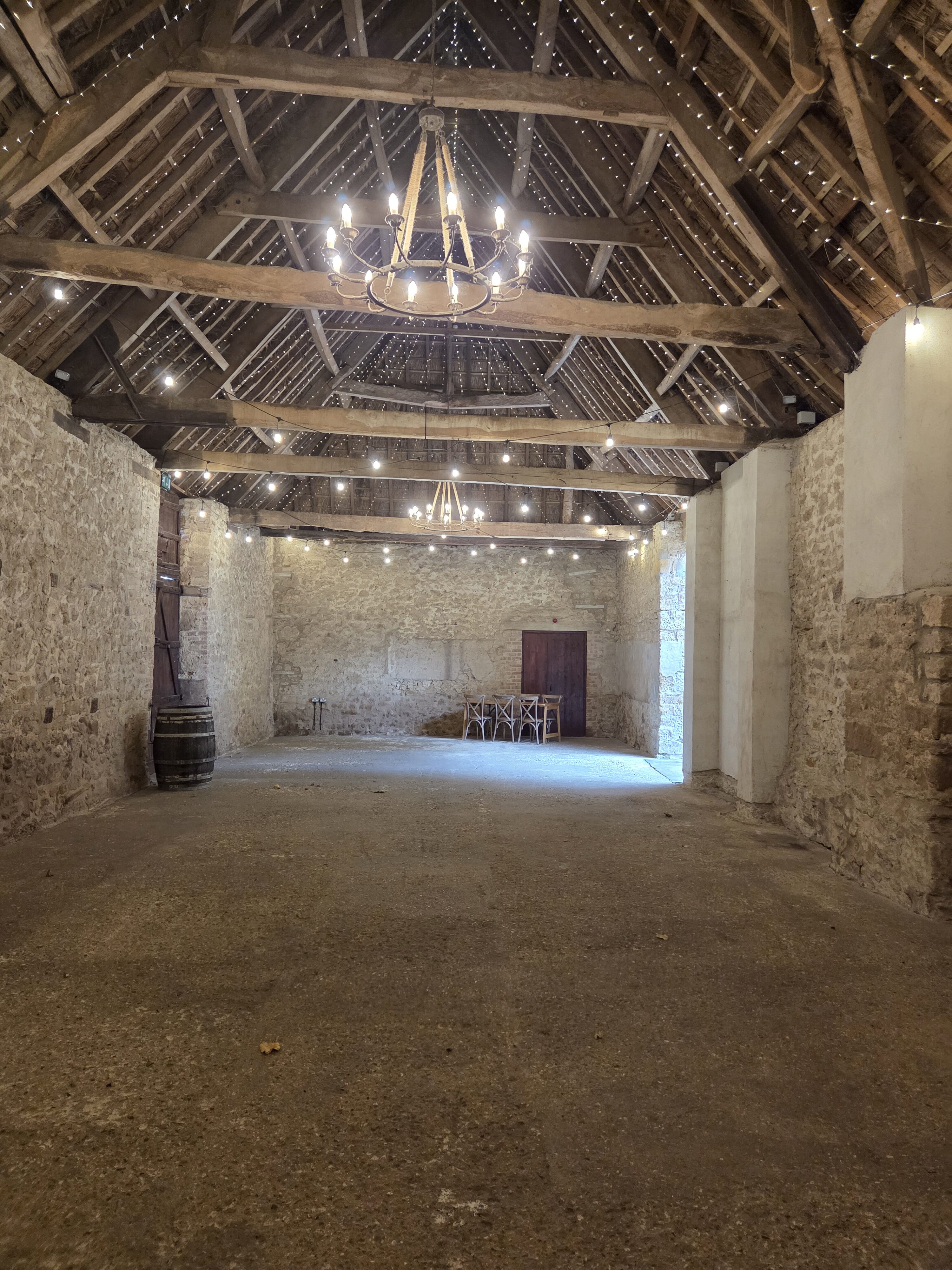
Set among the fields and woodland of the estate, this historic stone and thatched barn has exposed wooden beams, fairy lights and rope-and-metal chandeliers. The result is a naturally atmospheric space that lends itself beautifully to relaxed, rustic wedding receptions.
The views across the Somerset countryside add to the appeal, while the outdoor areas offer additional opportunities to enjoy the setting.
The Cider Barn is a dry-hire wedding venue, making it an attractive choice for couples who want to take a hands-on approach to planning their celebration. The venue’s flexibility allows couples to choose their own caterers and suppliers and create a reception that reflects their personalities.
The barn can accommodate up to 120 guests for a formal dinner, with additional possibilities for using the covered areas and outdoor space. The venue also has a walled garden and an outdoor stretch canopy, which provides a useful covered area for drinks and mingling when the weather is uncertain.
For couples planning an outdoor ceremony, an indoor reception or a celebration that makes use of both spaces, this flexibility is particularly appealing. It does, however, make it important to plan furniture layouts and wet-weather arrangements carefully.
You can find more information directly on the Dillington Estate wedding venue website.
12. Your barn wedding reception planning checklist
Once you have booked your venue, use this checklist to keep the practical details under control.
Venue and layout
- Confirm guest capacity for dining and the evening reception.
- Obtain floor plans for both indoor and outdoor ceremony arrangements.
- Check what furniture and equipment are included.
- Confirm access times for deliveries, setup and clearing up.
Catering and suppliers
- Confirm the kitchen facilities and equipment available.
- Agree delivery, preparation and service times with your caterer.
- Establish who supplies crockery, glassware, linen and serving equipment.
- Confirm who is responsible for clearing up and removing waste.
Facilities and comfort
- Check toilets, accessibility, parking and lighting.
- Plan heating and shelter for cooler or wet weather.
- Confirm the location of coats, bags and personal belongings.
Ceremony and wet-weather backup
- Decide how and when the decision to move indoors will be made.
- Allocate people to move furniture and decorations.
- Identify where guests will wait during a room changeover.
- Share the alternative layout with all key suppliers.
Evening reception
- Confirm the position of the bar, band or DJ and dance floor.
- Check sound restrictions and finishing times.
- Plan the final departure, transport and collection of belongings.
The earlier these details are agreed, the less you will need to worry about on the day itself.
Final thoughts: a beautiful barn wedding is all in the planning
A barn wedding offers something that many traditional venues cannot replicate: a space with history, character and a strong connection to the surrounding countryside.
But the secret to a successful barn wedding reception is not simply beautiful decorations or a stunning setting. It is making sure that every practical detail works together, from the first welcome drink to the last dance.
Think carefully about your seating plan, catering arrangements, toilet facilities, lighting and heating. Most importantly, have a clear wet-weather plan that considers not only where the ceremony will take place, but also how furniture, suppliers and guests will move around the space.
With the right preparation, you can enjoy all the charm of a rustic barn wedding without the last-minute stress.
And if you are dreaming of a countryside celebration in Somerset, The Cider Barn at Dillington Estate, Ilminster, is well worth exploring. Its beautiful barn, far-reaching views and covered outdoor space provide a lovely starting point for creating a wedding reception that feels completely your own.
Planning a barn wedding? Take the time to visit your chosen venue, walk through your proposed arrangements and ask plenty of practical questions. A little preparation goes a long way towards making your wedding day feel effortless, welcoming and unforgettable.
Would you like help with your seating plan? Click here for my blog containing useful tips How to make a wedding breakfast seating plan – weddingregency.co.uk